Many parents, teachers and carers are looking for games that children genuinely enjoy, but that don’t behave like a “bottomless pit”. Large online platforms (for example Roblox) can keep children engaged for a long time through constant goals, unlocks and social features that are hard to fully supervise.
Squishy Games goes in the opposite direction: short, self-contained rounds, shared play on one screen, and clear rules. This makes it easier to set boundaries around play time while still keeping what matters most: real emotions, laughter and group connection.
Below, we outline what to look for when you want a safer alternative to online games - and why the Squishy Games format is practical from that point of view.

Wrapping up the week at the office. A few quick games, a bit of relaxation, and plenty of laughs.
1) A safe environment: no chat, adverts or strangers
In many online games, the biggest challenge isn’t the gameplay itself, but the “surroundings”: chat, public servers, random encounters, and sometimes adverts or prompts designed to keep players online.
With Squishy Games, play happens locally - in one place, with people who are physically present:
- no chat and no contact with strangers
- no random online matchmaking
- shared play that is visible to a parent or teacher
For adults, that simply brings peace of mind: the child doesn’t “disappear” online, but plays in a space you can realistically oversee.
2) Short, clearly defined rounds instead of “just one more level”
Big platforms are often designed so players feel there is always “something else”: another level, badge, reward, item or mission. That makes it harder to end a session at a natural moment.
Squishy Games works differently: rounds are short and clearly defined. Most games last up to 2 minutes and take place on a single board. This makes it easier to:
- set limits (“20 minutes”, “five games”)
- pause without protest (“swap players after two games”)
- play for the fun of it, not to unlock the next thing
This matters especially at home and at school, where time is limited and games should be an addition - not a plan for half the day.
3) Child-friendly content: no brutality or unpredictable themes
In online environments, content can be mixed. Some worlds and modes are “for kids”, but right next to them you may find themes that are scary, aggressive or simply not age-appropriate.
In Squishy Games, the characters are soft, playful “squishy” figures, and the mini-games focus on pace, humour and simple, readable competition. Everything that happens in the game is visible on the screen once the game has started. From an adult’s perspective, that means:
- less risk of unwanted content
- easier matching to the age of the group
- more predictability in what children will see on screen
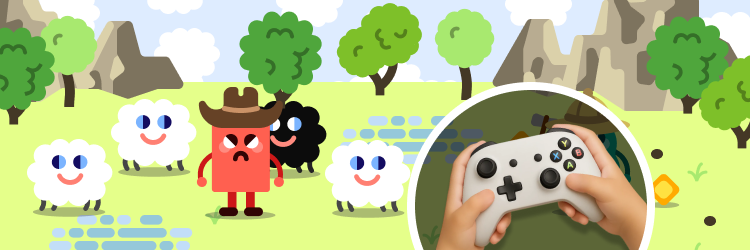
Squishlies - soft, squishy characters for every game.
4) More active reactions, less passive scrolling, watching and grinding
Many online games involve long stretches of “being in the world”: walking around, collecting, building and completing tasks. That can be valuable, but it often turns into long sitting and high stimulation.
Squishy Games offers short mini-rounds where the key things are:
- reflexes and quick decisions
- hand–eye coordination (played on Xbox/PC-style gamepads)
- reacting to other players in real time
Children don’t “scroll” through a world for hours. They play intensely for a short moment - and a break comes naturally, typically after 2 minutes of a gameplay.
5) Development along the play: reflexes, coordination, cooperation
Well-designed mini-games can build skills without a classroom tone. In Squishy Games you can clearly see practice in:
- reflexes and timing (responding to cues)
- dexterity and coordination (control and precision)
- observation and memory (board layout and patterns)
- cooperation or healthy competition (depending on the game)
That makes it useful both for play at home and for group settings (after-school clubs, integration activities, breaks and events).
6) Playing together: shared emotions instead of a solitary “bubble”
One of the biggest differences between local games and online games is simple: is the child playing alone, or with people right next to them?
In Squishy Games everyone looks at the same screen. There are reactions, laughter, comments, cheering and “rematch!” - all in the same physical space. This play format:
- supports group bonding
- builds relationships
- lets children see, hear and read each other’s reactions - their own and everyone else’s
- gives adults insight into children’s emotions (and a chance to talk about them)
Games stop being a separate world and become a shared activity.
Summary
If you are looking for an alternative to large online platforms, Squishy Games is a sensible option because it combines three things that are often missing in online gaming:
- a safer, local environment (no strangers and no chat)
- short, self-contained rounds (easy to manage)
- shared play on one screen (emotion and connection instead of isolation)
It is still real fun - just in a format that fits more easily into home and school safe routines.
--
LavaVision team – designers of educational and interactive applications. Creators of Squishy Games for Motioncube.
Squishy Games is a collection of 24 gamepad mini-games for Xbox/PC-style controllers. It offers engaging, safe shared-screen gameplay for up to 4 players. Designed for kids 7+, teens and families - ideal for short, shared play sessions.
You can read more about the game collection in the Squishy Games' description.
Roblox is a trademark of Roblox Corporation. This article is not affiliated with or endorsed by Roblox.
